Speak Like a Local: 7 Papiamentu Words You'll Use Every Day in Curaçao
Learn 7 Papiamentu words you'll use every day in Curaçao, from "bon bini" to "dushi", with easy pronunciation tips from a local guide.
Bon bini! The moment you land in Curaçao, you will hear it: a warm, rhythmic language that sounds a little Spanish, a little Portuguese, and completely unique. That is Papiamentu, the local language of Curaçao.
Most people on the island also speak English, Dutch and Spanish, so you will never get stuck. But I always tell my guests: learn just a few words of Papiamentu and you will see the difference. Locals light up when visitors try.
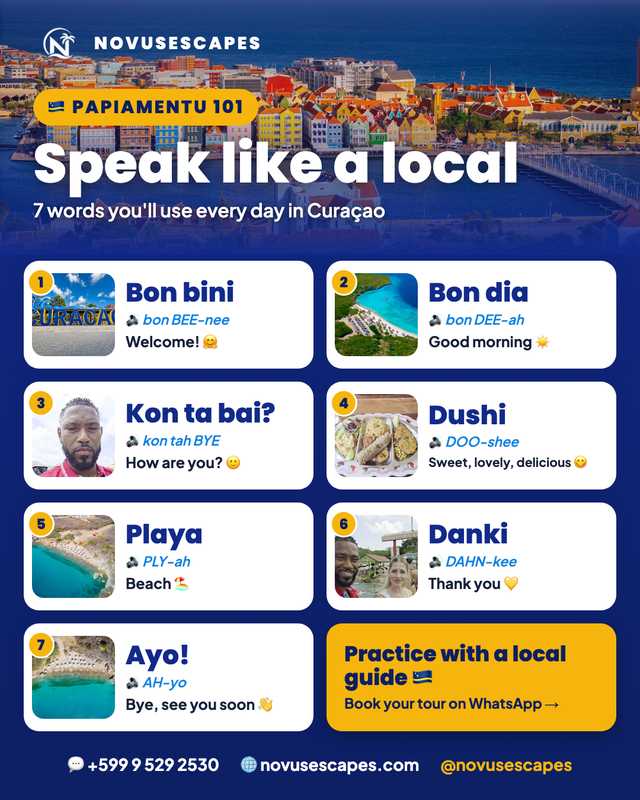
Here are the 7 words you will hear (and use) every day in Curaçao.
What is Papiamentu?
Papiamentu is a Creole language that grew up in Curaçao over hundreds of years. It mixes Portuguese, Spanish, Dutch and African languages, and it is one of the official languages of Curaçao. You will hear it in homes, on the radio, at the market and on the street. It is a big part of who we are.
1. Bon bini (bon BEE-nee): Welcome!
This is the first word you will see when you arrive, on signs at the airport, in shops and at restaurants. It is how Curaçao says hello to every visitor.
When to use it: you will mostly hear it, but you can use it too when you welcome friends to your table.
2. Bon dia (bon DEE-ah): Good morning
Locals greet each other a lot, even people they do not know. Walking into a shop or a snack bar without a greeting can feel a little cold here.
When to use it: in the morning, when you walk into a shop, get on a bus, or pass someone on the street.
3. Kon ta bai? (kon tah BYE): How are you?
A friendly everyday greeting that you will hear all day long.
How to answer: "Mi ta bon" (I'm good). Add "danki" at the end and you will sound like a local.
4. Dushi (DOO-shee): Sweet, lovely, delicious
This is the most famous word on the island. Dushi can describe food, a beach, the weather, a song, or someone you love. If something is nice, it is dushi.
When to use it: after your first bite of pastechi or keshi yena, try saying "Esaki ta dushi!" (This is delicious!). Read more about our local food in "3 Curaçao Foods You Must Try."
5. Playa (PLY-ah): Beach
You will see this word everywhere, from Playa Lagun to Playa Porto Mari. Curaçao has more than 35 beaches, so you will be using it a lot.
When to use it: when asking for directions or reading road signs on your way to the coast.
6. Danki (DAHN-kee): Thank you
Simple, useful and always appreciated.
Want to say thank you very much? Say "Masha danki."
When to use it: everywhere. With your waiter, your driver, the person at the beach entrance, and of course your tour guide.
7. Ayo! (AH-yo): Bye, see you soon
The perfect way to say goodbye. It feels warmer than a simple "bye", almost like "see you again."
When to use it: when you leave a shop, a restaurant, or at the end of your holiday.
Quick cheat sheet
Bon bini: Welcome
Bon dia: Good morning
Kon ta bai?: How are you?
Mi ta bon: I'm good
Dushi: Sweet, lovely, delicious
Playa: Beach
Danki / Masha danki: Thank you / Thank you very much
Ayo: Bye, see you soon
Tip: save this post or take a screenshot of the cheat sheet so you have it with you on the island.
Do not worry about pronunciation
You do not need perfect pronunciation. People in Curaçao love it when visitors try, and a little Papiamentu goes a long way. Even one "bon dia" can start a great conversation.
Practice with a local guide
The best way to learn Papiamentu is from someone who grew up speaking it. On a Novus Escapes private tour, your born-and-raised local guide will teach you the words, share the stories behind them, and take you to the places where you will hear them every day.
We pick you up from your hotel, the cruise port or the airport in our private air-conditioned van, and plan the day around you.
✅ Free cancellation up to 24 hours before your tour
💵 Payment in cash at the end of your tour
💬 Questions? Message us on WhatsApp: +599 9 529 2530
Masha danki for reading, and ayo! See you soon in Curaçao.